While most spinal surgeries are associated with a posterior approach, in the ALIF technique the surgeon accesses the spine through the abdomen. This approach allows the paraspinal muscles to be bypassed entirely, enabling precise stabilisation of the lumbar segment while minimising damage to surrounding tissues. It is a modern approach used in the treatment of lumbar spine pain caused by degenerative disease or other conditions and injuries.
As the name suggests, ALIF — Anterior Lumbar Interbody Fusion — involves stabilising the lumbar spine via an anterior approach. This approach has several advantages over the classic posterior approach, as it is far less invasive. Surgeons work through natural anatomical spaces, which means muscles do not need to be stripped or denervated, allowing patients to retain greater function after the procedure. Furthermore, from this approach it is possible not only to perform spinal stabilisation surgery, but also to implant an artificial disc prosthesis.
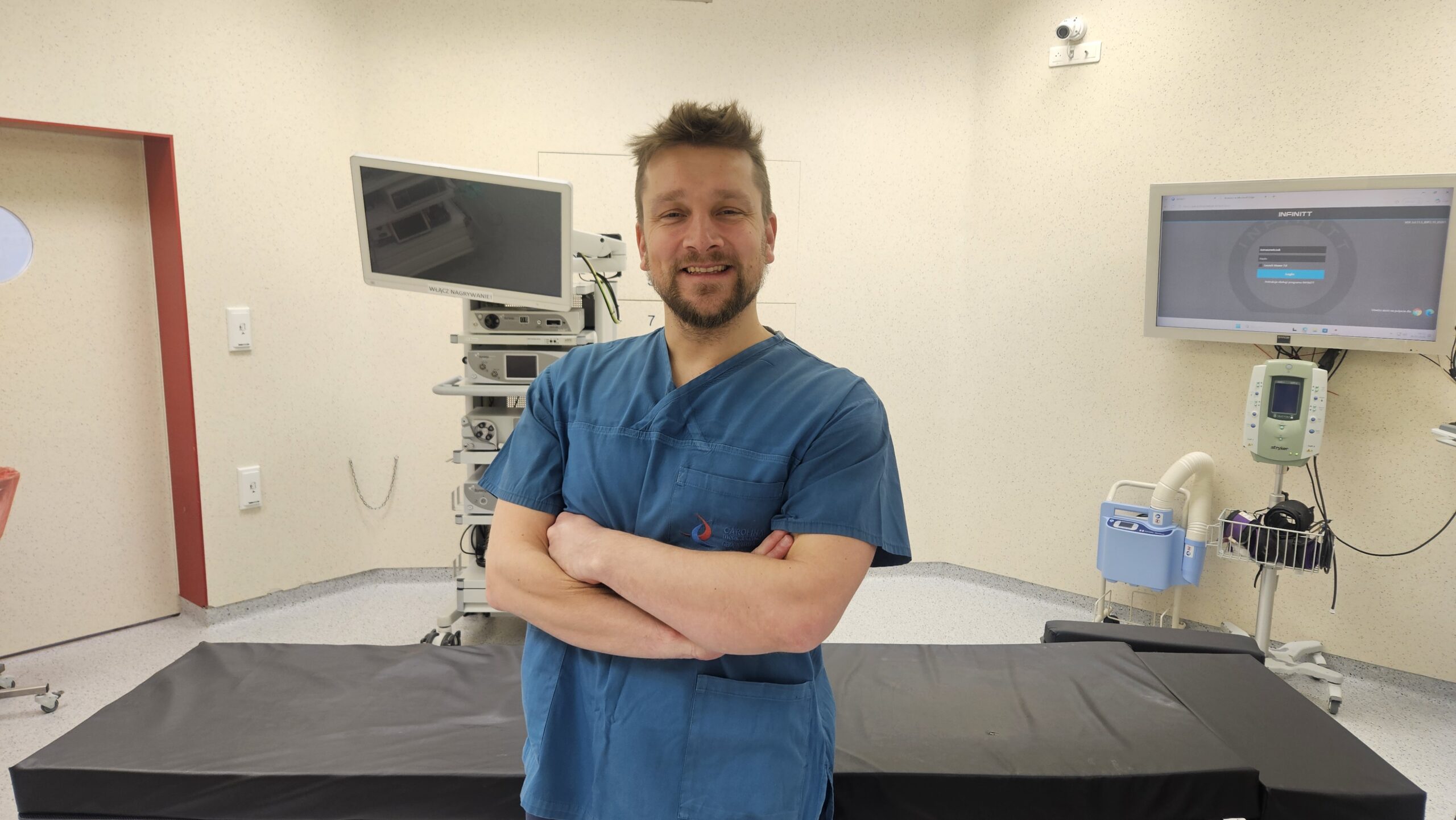
MD JAKUB MOCARSKI, ORTHOPAEDIC SURGEON SPECIALISING IN SPINAL SURGERY
What does anterior approach surgery involve?
During ALIF surgery, the surgeon makes an incision at the front of the lower abdomen — similar to a Caesarean section — to gain access to the lumbar spine. The length and location of the incision may vary depending on the patient’s anatomy and the extent of the procedure.
The surgeon then carefully divides the layers of muscle and tissue. The abdominal organs and blood vessels are gently moved aside. The surgeon removes the damaged disc between two adjacent vertebrae and inserts an implant. This helps stabilise the spine and promotes fusion between the vertebrae, reducing pain and improving spinal function.
ALIF surgery is typically performed under general anaesthesia and may require a short hospital stay.
When do surgeons use the ALIF method?
The anterior approach is used in cases of degenerative disease, fractures and spondylolisthesis — a condition in which one vertebra slips forward over the one below, leading to instability and nerve compression.
The anterior approach is most commonly used in cases of degenerative disease (commonly known as disc disease), particularly when collapse of the disc surface occurs at the lowest level — where the lumbar spine meets the sacrum, at the L5-S1 level. The nerves lose the space in their natural exit windows from the spine. Patients often notice that standing in one position causes progressive pain, forcing them to crouch or lean forward. Removing the degenerated disc and replacing it with an implant restores the correct intervertebral space height, thereby relieving the symptoms that appear during everyday activities.
MD JAKUB MOCARSKI
Advantages of ALIF
Patients may experience less post-operative pain.
The greatest benefit — beyond the scar placement, which is almost invisible — is that the paraspinal muscles responsible for spinal stabilisation are left completely intact. In posterior approach surgery, the muscles are detached from the spine and consequently lose part of their nerve supply, undergoing fatty degeneration and becoming less functional. Patients who undergo ALIF retain greater muscle mass and are not exposed to the pain associated with denervation of the paraspinal muscles that occurs with the posterior approach.
MD JAKUB MOCARSKI
The goal of spinal surgery is to achieve bony fusion. The anterior approach allows much more thorough preparation of the intervertebral space, creating far better conditions for fusion. Additionally, this approach provides greater stability, decompression and restoration of correct spinal balance (lordosis).
MD JAKUB MOCARSKI
What will spinal surgery bring in the coming years?
Spinal surgery is moving towards minimally invasive procedures, with increasing emphasis on making operations as unburdensome as possible for the patient. In some cases, after ALIF surgery — in patients who have damage to the ligamentum flavum (which functions as a hinge at the back of the spine) — additional posterior stabilisation is required. Thanks to advances in minimally invasive techniques, this stage no longer requires extensive open surgery. Much smaller incisions and percutaneous stabilisation can be used, significantly reducing tissue trauma, accelerating healing and return to activity.
MD JAKUB MOCARSKI
Learn more about interbody spinal stabilisation techniques: click here






 ALIF_word_LUX MED Szpital Carolina.docx